Tuesday, January 10, 2012

Foodistan : About Chef Wars

These days the Ndtv Good Times channel is showing frequent promos of their upcoming show Foodistan which debuts on 23rd January. Foodistan is a cookery show wherein professional chefs from India and Pakistan compete against each other to dish out the best of recipes. The show is being produced by Siddharth Basu's Big Synergy and is the most expensive show of any kind that the channel has ever made. The judges panel consists of Vir Sanghvi (India), Sonya Jehan (Pakistan) and Merrilees Parker (celebrity chef from Britain).The hosts are Ira Dubey and Aly Khan. Refer Vir Sanghvi's blog for more interesting details.

Since I saw the promo, I have been waiting very eagerly for the launch of the show. Prior to this, Ndtv Good Times  had another competitive food show called Pressure Cooker.It had only 6 contestants who were amateur cooks and who were handpicked by the judges.The fact that the show concept was very unique was the only thumbs up. Everything else, from the excitement level to the suspense to the degree of hardness were a huge letdown. Hopefully Foodistan will be nothing like this and will come true to the high expectations we all have of it :). Hopefully, it has all the drama quotient and hopefully we would get to see some good recipes, especially from across the border.

Time for some food diplomacy, my friends :)

The Secret Behind 'Firm' Potato Cutlets


I have made several attempts at cooking potato cutlets.But I have always ended up with super soft and delicate cutlets that break very easily. The damage can happen at any stage of the cooking process; either when making the patty, or when transferring it to the frying pan, or when flipping it so that it cooks on the other side, or when removing from the frying pan onto the plate , or even when you so much as lift it to eat it :). Needless to say, making these potato cutlets requires a great deal of care and the cooking procedure while pretty simple is actually riddled with several pressure points.

So I turned to the internet (my saviour !!) to look for a workaround . I learnt that the reason potato cutlets break is due to high moisture content. This will happen if the potato has been mashed when still warm or if the water has not been completely drained from the potato before mashing it. In my case, the problem was occurring because of the potato being mashed when still hot; for some reason, I thought it will be easier to mash when still warm; when the trapped hot air inside the potato condenses, it makes the mash soggy. Apart from this, many forums and blogs also recommended dusting the cutlet with bread crumbs or semolina or maida or corn flour to give it the firm texture.Sometimes, these can also be mixed with the mash. Not only does this stiffens the cutlet but also makes it crispy when fried.

Have fun making aloo tikkis!! 

Monday, January 9, 2012

Hard-boiled Eggs

In the last week, I had to prepare hard boiled eggs on a couple of occasions. Unlike my expectations, it wasn't a smooth ride and I had several frustrating moments trying to find my way around those small white innocent but beastly things.Once all the egg white oozed out while the egg was still simmering in the water, and on another occasion I removed the eggs from the heat prematurely, consequently ending up with runny eggs.Peeling the eggs was another pain and I had to do the peeling at a really snail's pace in order to ensure that the whites didn't get detached along with the shells.Not to mention that the cooking process is greatly influenced by the shape, size, quantity, temperature and freshness of the eggs.

So I resorted to the internet to look for some tips on getting perfect hard boiled eggs. Surprisingly, there was a load of information dedicated to this seemingly simple topic, much to my delight. Ok, so I am not the only morone who doesn't know how to boil an egg :). Below, I have listed down the useful links I referred.

1. http://simplyrecipes.com/recipes/how_to_make_perfect_hard_boiled_eggs/
2. http://www.wikihow.com/Hard-Boil-an-Egg
3. http://whatscookingamerica.net/Eggs/BoiledEggs.htm

Enriched by all the information that I have gathered, I hope I can cook the perfect boiled eggs next time, and do that without having egg on my face :)

Monday, October 17, 2011

Olive Oil


Most of us would have seen olive oil in supermarket shelves but felt confused by the different grading and types of olive oil available.In this post, I will try to reduce that confusion by talking about the different varities of olive oil available in India and when to use which type of oil.

Olive oil is mostly imported in India from Spain. Spain, Italy and Greece are together responsible for nearly 75% of the worldwide production of olive oil.Olive oil generally comes in four varities namely, extra virgin, virgin, pure and refined.These differ primarily in their processing and acidic content.Olive oil is extracted from it's fruit by pressing it. This extracted oil may sometimes have a high acidic content and unpleasant aroma and is therefore unpalatable.In this case, the oil needs to be further refined using chemicals or by other means.

Virgin olive oil comes from first pressing and is produced without refining.It has acidity less than 2% and is considered to have good flavour. It can be used in uncooked form.

Extra virgin olive oil is also obtained in same way as virgin olive oil.However it has acidity level of no more than 0.8% and is considered to be superior to virgin olive oil.It has a slightly fruity taste and is used uncooked.

Refined olive oil are ones that have been obtained by further refining virgin olive oil.Hence, they become clear, odourless and flavourless and have an acidity content below 0.3%.This gives them a long shelf life. Since they are completely flavourless, they are used only for low to mid-temperature frying. They cannot be used uncooked. Refined olive oil is rarely sold as-is and is generally blended with virgin olive oil to impart some flavour.

Pure olive oil is nothing but a blend of refined olive oil and virgin olive oil.The virgin olive oil is used to impart flavour and this type of olive oil can have an acidity content of not more than 1.5%. Generally, oils in this category contain about 85% refined olive oil and 15% extra virgin olive oil.Pure olive oil has a high smoke point and hence can be used for high temperature frying.

So now that we know the different types of olive oil, let's see when to use which type. Extra virgin and virgin olive oil can be used uncooked in salads, marinades or with bread. Pure and refined olive oil is generally used for frying purpose. Refined olive oil is produced in more abundance compared to virgin olive oil and hence is lot cheaper. Keeping all this in mind, it is best to stock your pantry with two types of olive oil - an extra virgin variety and pure olive oil.

Extra virgin olive oil has lower shelf life and should be purchased in smaller quantities, say 250 ml at a time. For pure olive oil, keep an eye out for discount packages and festival offers, and you can purchase it in abundance.Since pure olive oil is mainly used for frying, it will get used up also very fast.Sometimes, you will even see extra virgin olive oil being sold in spray bottles. Buy this only if you are very conscious about the quantity of olive oil you use in your recipes.

This post cannot be complete without talking about the health benefits of olive oil.Olive oil is considered to be one of the most healthy oils, because of it's high mono-saturated fat content and relatively low saturated fat content.Olive oil helps in regulating cholestrol levels and keeps the heart healthy.

Enjoy cooking with Olive Oil !!

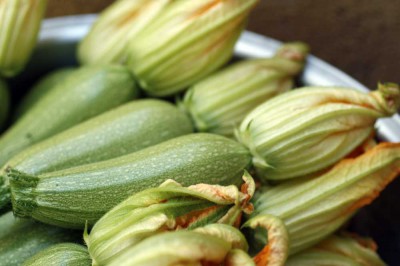
Zucchini and Pumpkin Flower Fritters


Today afternoon, I was watching David Rocco's food show on Fox where he prepared fritters (equivalent for Indian Bhajji) with zucchini flowers.Later in the evening, I was seeing Chef Vineet Bhatia's show where he was eating pumpkin flower fritters at an Oriyya restaurant.The zucchini and pumpkin flowers look very similar, but I am not sure whether they taste also similar.

In David Rocco's italian version of zucchini flower fritters, the batter was prepared with maida, eggs and cold water.The zuchinni flowers were cleaned delicately, stuffed with mozarella cheese cut lengthwise and with chopped sardines.The flowers were then gently dipped in the batter, coated and deep fried in olive oil.The seasing was added on top of the fried flowers.

The Oriyya version of pumpkin flower fritters was not demonstrated, but I am guessing that the recipe used besan (instead of maida) and the batter was seasoned with spices prior to the deep frying, as there was a distinct yellow-reddish colour on the fried flowers.

To make the flowers more light and crisp, little pinch of soda bicarb can also be added.

I have never seen either of these two flowers being sold in Bangalore. But, I thought of sharing the recipe as it definitely looks very appealing :)

O'live it Up !!


In this post, I am going to talk about the olive fruit, which is a very common ingredient in Italian and Mediterranean dishes such as pastas and pizzas.Olives do not grow in India. The ones you see under the Del Monte brand in supermarkets are imported from Spain, which is the world's largest producer of olives.

Olives are inherently bitter in taste.Hence they need to be cured so that they become more palatable.The Del Monte olives are cured in brine (which is nothing but salt water).Oil and lye can also be used for curing olives.

Olives are available in two colours, green and black.The green ones are picked when still unripe, whereas the black olives are fully ripe.The green olives will therefore be firmer to bite and more bitter and tangy compared to the black olives.The black olives are generally more smooth and bland in taste.However, as a general rule, the taste of olives does not depend on it's colour but on the extent of curing and the nature of curing it has undergone.

Both the black and green olives are sometimes sold in the pitted form.This means that they have been de-seeded.They can also be sliced into smaller pieces before being packaged.The Del Monte brand of olives also consists of green olives that are stuffed with pimiento which is a type of sweet red pepper.Since, I am not aware of many dishes that require whole olives, I generally go for the sliced olives.The stuffed olives also pack in a lot of flavour, but I have not used them yet in any of my dishes.For most other purposes, the green and black olives can be used interchangeably.

Olives are rich in Vitamin E. The Del Monte olives have a shelf life of 36 months.Apart from being used in pastas and pizzas, olives can also be used in salads, sandwiches and burgers.It is really a must-have ingredient for any avid cook :)

Sunday, October 16, 2011

Having Fun with Pasta


Although there are more than a hundred different varities of pasta, most of us living in India would be familiar only with Macaroni pasta.That's because Macaroni is the cheapest form of pasta available here and is manufactured within India.Most of the other forms of pasta such as Spaghetti,Fusilli,Penne,Lasagne etc. are imported and hence are more costly and available only in selective supermarkets.(However I have not yet managed to spot Lasagne sheets in any of supermarkets I've been to in Bangalore)

Pasta is generally made of wheat flour,water and sometimes eggs.If the pasta contains eggs , it remains fresh for only a few days, whereas pasta that does not contain eggs can remain edible for at least a year.The ingredients that go into making the pasta determine it's taste and colour e.g if a herb paste is added to the pasta dough, then the pasta colour would be green.The tricolour pastas that you see in the market have been flavoured with tomato and spinach powders. The shape of the pasta does not influence it's taste, however it does have a bearing on the pasta cooking time.Different kinds of machines are used to make different pasta shapes.Some of the most basic pasta machines can even be ordered online.They are extremely useful if one wants to make fresh pasta.

Pasta is cooked by using the boiling technique.Once the pasta has been immersed in the boiling water, the water should be allowed to just simmer.Also don't forget to add salt to the water, else the pasta will taste absolutely bland.If during the process of cooking, the pasta starts to get sticky, it's advisable to put a few drops of oil in the water.The common guideline for cooking pasta perfectly is that it should be cooked till it's al dente.This means that the pasta should not be too soft and should be firm to bite.The cooking time of pasta depends on it's shape and thickness.The cooking instructions can generally be found on the plastic cover.

The most common way of cooking pasta is to serve it with some kind of sauce with a sprinkling of cheese on top.There are a huge variety of sauces that can be served with pasta.Most of these are simple to make, and some are even available pre-packaged in supermarkets.However, the pasta sauces available in supermarkets are not only expensive, but they also have a certain marked taste due to preservatives.Using fresh sauce is recommendable as it mostly just involves pushing in few ingredients into a blender to form a paste and later cooking that paste in a saucepan with some milk or cream and cheese.Apart from this, pasta can also be served cold as some form of salad.

Pasta dishes are traditionally prepared in olive oil.However, olive oil is expensive and if you don't wish to purchase it, you can still use the usual refined oil for cooking pasta.

Most pasta dishes require microwave baking towards the end.This is needed to melt the cheese and to bind together the different components of the dish.But since I don't own a microwave yet, I usually skip this step and the results are not at all disastrous :).

In my later posts I will be sharing some pasta recipes.As pasta is one of my favourite dishes, it is only fit to have started this blog with a post on the mighty pasta.Bon Apetite!!